Global Safe Technologies (Australia) Pty Ltd. - Client Information
|
||||||||||||||||||||||||||||||||||||||||||||||||
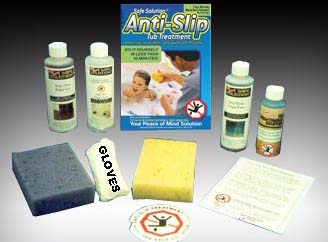
Bathtub Application Treatment InstructionsStep 1 Put on the supplied gloves. Place one of the supplied sponges on the bottom surface of the Bathtub. Take the bottle marked "STEP ONE – PREP/CLEANER" and pour contents onto the sponge. Proceed to clean the entire bottom surface of the bathtub and the interior sides of the bathtub with the Prep / Cleaner solution. Rinse thoroughly with water and remove the sponge. Be sure that all Prep / Cleaner residue has been completely rinsed away. Proceed to next step. Step 2 Keeping the gloves on, close the drain. Take the second sponge and place it on the Bathtub’s surface. Pour the entire contents of the bottle marked “Step Two – Treatment” onto the sponge. Move the sponge slowly and carefully around the entire bottom walking surface only of the Bathtub, for approximately 5 minutes. Any longer than 5 minutes is not recommended. Do not splash product and do not allow any areas you are treating to dry in this time period. There is no reason to treat anything but the tubs bottom / walking surface. Step 3 Take the entire contents of the bottle marked “Step Three – neutralizer” and pour it into the Bathtub. Using the same sponge, completely mixing the solutions together. This will convert the treatment into a biodegradable and nontoxic residue. Now, simply open the drain and thoroughly rinse with clean water. It’s just that simple.
|
||||||||||||||||||||||||||||||||||||||||||||||||
Bathtub ObservationsHotels have a point system for determining the level of cleanliness and tidy appearances of their hotels. Bathtub mats are unsightly and unnecessary. In the health care industry, due to their ability to grow and maintain bacteria, hospitals do not use strips or mats on their tubs. A quality rubber bathtub mat is approximately $5.00. In high occupancy services, the life of a bathtub mat is less than six months. The suction cups of the bathtub mat collect fungus if not properly cleaned and sanitized after each use. The cleaning process represents several minutes of distasteful labour. Many people would rather risk a slip-fall accident than clean a bathtub mat. Friction self-adhesive tapes or pads are costly because they are always popping up and require frequent replacement. It is widely recognized that they are unattractive, but more importantly, they collect dirt, bacteria and mildew. Everyone dislikes them; guests, management, housekeeping and the local Health Department. Some bathtubs are treated at the factory with a non-skid material in the form of large dots or vertical lines, which are applied to the base of the bathtub. You can always spot this tub by the designs on the bottom. Sometimes there will be vertical lines running across the tub. These are questionable protection from slip-fall conditions, when soapy residues exist. Also, depending on the frequency of use, the non-skid feature wears off where it is needed most. A factory treatment is more costly and will last about two years in busy hotel use. When the non-skid material wears off, the bathtub gets slippery when wet. The bathtub becomes slippery and hazardous. The hazard is compounded when your guest is led into a false sense of security, believing the bathtub is safe; when in fact, it is slippery. The Safe Solution® works very well on this type of tub. In most cases the Safe Solution® installation will remove the gray designs that were put on at the factory. After application is completed, if the remaining residual did not completely dissolve, during application, then the use of handheld scrub brush is recommended. Did I mention that it is gray because of fungus and bacteria lodging inside the surface abrasive design? Yuck!!!! There are several kinds of bathtubs on the market. Ceramic porcelain and steel - enameled / glazed tubs are best and comprise the highest market percentage. Treating a bathtub standing surface takes no more than 10 minutes from beginning to end. Plastic, acrylic, or fiberglass tub types will not be affected in any way by the “Safe Solution®”, so we don’t treat them. They are less durable and even more expensive than the steel-enamel and porcelain tubs. They scratch and have been known to crack, which is something hotels cannot afford to have happen. They are also more expensive and are not environmentally practical. There was a trend toward their use, but a resurgence of steel enamel tubs assures our long and fruitful market position. . In older hotels and motels you will come across refinished/reglazed tubs. The refinishing process is known by many fancy names, but mostly as a re-glazed surface. Those people in the business usually try to give the impression that they are adding porcelain to the tub. It cannot be newly kiln-fired. What in fact they are doing is giving the tub a quality painting. This painting job does not adhere to the porcelain and will eventually peel. This is why many prospects are concerned if the Safe Solution® is a coating, which if course it is not. The Safe Solution® does not work on plastic or painted surfaces. It will not work on a refinished tub. A bathtub without strips or mats looks cleaner and is easier to clean. The 'Safe Solution®' does not cost – it pays! It’s cheaper than strips or mats and MUCH cheaper than a slip-fall lawsuit. |
||||||||||||||||||||||||||||||||||||||||||||||||
Bathtub Mats vs. Safe Solution®
Click to load down calculator that can assist you to calculate your specific savings If the objective of placing a bathtub mat originally was to reduce or eliminate slip and fall accidents, they are NOT an adequate solution to the problem. Guests will often NOT use the bathtub mat, particularly as bathmats attract dirt and bacteria and may look unappealing. That’s a potential hazard. The Hotel housekeeping is fed up with cleaning and maintaining the mats. Mats need to be regularly laundered and replaced. In addition, they are a perfect breeding ground for fungus and bacteria. Even if the above cost savings reflect only a fraction of the actual expenses, why endure the extra expense unnecessarily? The SAVINGS alone, by using the Safe Solution®, are equivalent to hundreds of FREE guess visits. There is only one viable solution… The Safe
Solution® |
Email: Click to Email Us Authorised Dealer Near You 23/159 Chifley Street |
|||
|
|
|||
|
|||
|